Premium Games, Free Games and Game Subscriptions Compared
Paying once, playing for free, or subscribing to a catalogue: how the three main ways of paying for mobile games compare on cost, ads and progress.
There are three main ways to pay for mobile games today. You can buy a game once, play a free game supported by ads and purchases, or subscribe to a service that gives you access to a catalogue of games. Each has strengths, and the right choice depends on how you play.
Premium games: pay once
A premium game has an up-front price. After that, you generally get the whole game with no ads and no purchases needed to progress, although some premium games do sell optional expansions.
Good for: players who like story-driven games, puzzle games with a clear ending, and anyone who dislikes being interrupted by offers.
Watch for: the price can feel high compared with free alternatives, and refunds after purchase follow the store's rules. See our guide on refunds.
Free-to-play games
Free games cost nothing to download and are funded by ads and in-app purchases, as explained in how free-to-play games make money.
Good for: trying lots of different games, playing casually for a few minutes a day, and multiplayer games where a large player base matters.
Watch for: timers, energy systems and offers designed to encourage spending. The total cost can be zero or very high, depending on your habits.
Game subscription services
Both major mobile platforms offer subscription catalogues. Apple Arcade is a subscription service on Apple devices, and Google Play Pass is a subscription on Android. They give access to a selection of games, and Apple Arcade in particular has emphasised games without ads or in-app purchases. Catalogues, prices and rules differ by region and change over time, so check the current details on each service's official page.
Good for: families, players who try many games, and anyone who wants a free-to-play style variety without the pressure to spend.
Watch for: games can leave a catalogue, and you lose access when you cancel. Check whether your progress is kept if you resubscribe later.
Side by side
| Premium | Free-to-play | Subscription | |
|---|---|---|---|
| Up-front cost | One-time price | None | Monthly or yearly fee |
| Ads | Usually none | Common | Usually none |
| Purchases to progress | Rare | Common | Usually none |
| Cost ceiling | Fixed | No limit | Fixed per month |
| Access after you stop paying | Keep the game | Keep the game | Usually lose access |
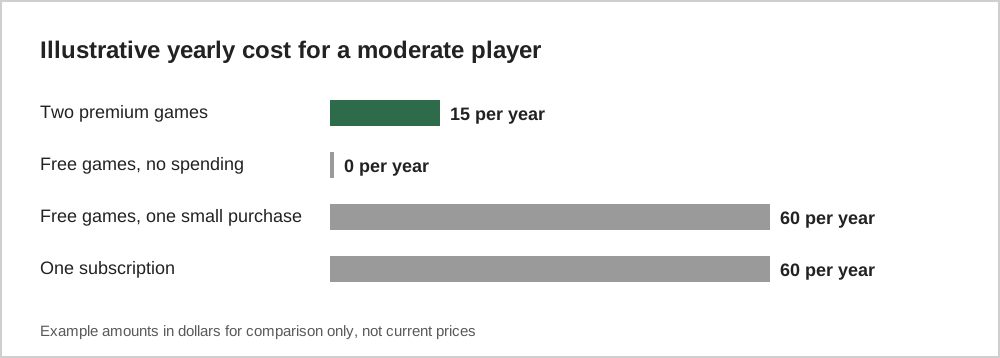
The chart is an illustration, not a price list. Its point is that the total cost of "free" depends entirely on your behaviour, while premium and subscription costs are predictable.
How to decide
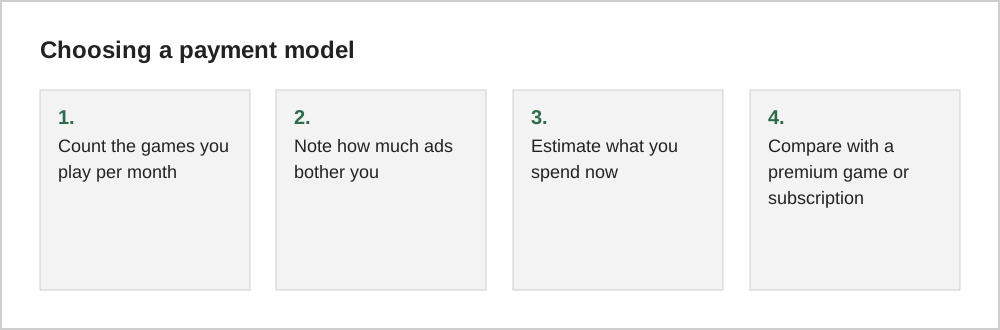
If you play one or two games for a long time and dislike interruptions, a premium game or a carefully chosen free game may be best. If you enjoy variety, a subscription can be good value. If you rarely spend money and do not mind ads, free games are hard to beat.
Mixing models is fine
Many players combine approaches: a subscription for variety, one or two free games they play daily, and the occasional premium game they have been looking forward to. The goal is not to find the single perfect model, but to know what each one costs you in money, time and attention.
Cost over time
A premium game might cost $6.99 once. A free-to-play game might cost nothing for months, then $4.99 for a monthly pass. After two months, the free-to-play game has cost more, and it will keep costing more as long as you keep the pass. Neither is better in principle; it depends on how long you play and how you enjoy spending.
A simple rule many players use is to estimate how many hours they will play in the next year and divide by the expected cost. Cost per hour is often lower for a premium game you play deeply, and sometimes lower for a free game you play lightly without paying at all.
Finding good premium games
Premium mobile games can be harder to discover because they spend less on advertising. Curated lists in the app stores, subscription services such as Apple Arcade and Google Play Pass, and reviews from specialist sites are useful starting points. Many premium games also offer a free demo or a few free levels.
The short version
Premium games have a fixed price and usually no pressure to spend. Free games cost anything from nothing to a lot, depending on your habits. Subscriptions offer variety for a predictable fee but end when you stop paying. Pick based on how many games you play and how much interruptions bother you.