Upgrade Priorities: A Simple Method That Works in Most Mobile Games
Most games offer far more upgrades than you can afford. A transferable way to decide what to upgrade first, based on bottlenecks and compounding value.

Almost every mobile game with progression offers more upgrades than you can afford: characters, buildings, cards, towers, research trees. Spreading resources evenly feels fair, but it usually makes progress slower. A little prioritisation goes a long way, and the same method works in very different genres.
Find the bottleneck
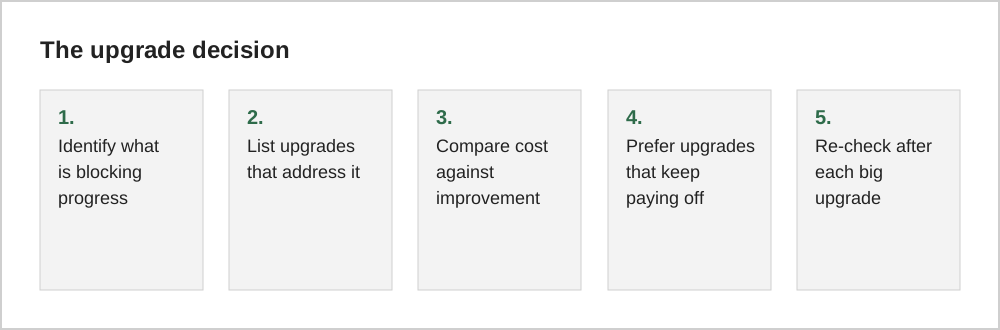
The first question is always: what is stopping me right now? If you cannot beat a level, the bottleneck might be damage, survivability or a missing ability. If progress is slow outside of levels, the bottleneck might be resource income or build time. Upgrading something that is not the bottleneck feels productive but changes little.
Prefer upgrades that compound
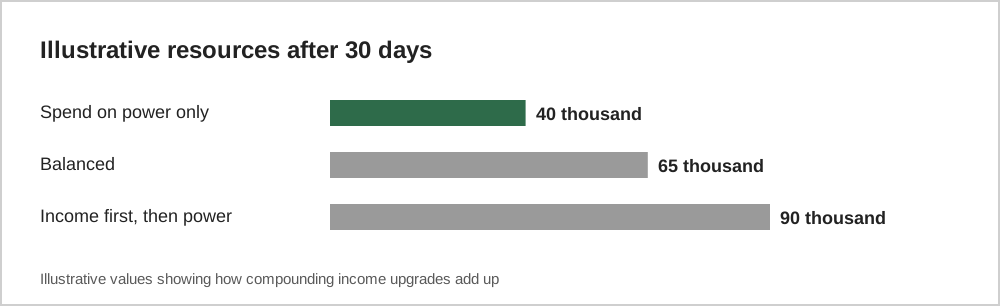
Some upgrades pay off once; others keep paying off. Upgrades that increase income, reduce costs, or speed up future upgrades compound over time. Early in a game, these are usually the best investments, even if they do not make you visibly stronger.
| Upgrade type | Pays off | Typical priority early on |
|---|---|---|
| Income or production | Every minute, forever | High |
| Build speed or queue slots | Every future upgrade | High |
| Core team damage or defense | When it unblocks levels | Medium to high |
| Cosmetic or minor stats | Rarely | Low |
Concentrate, then broaden
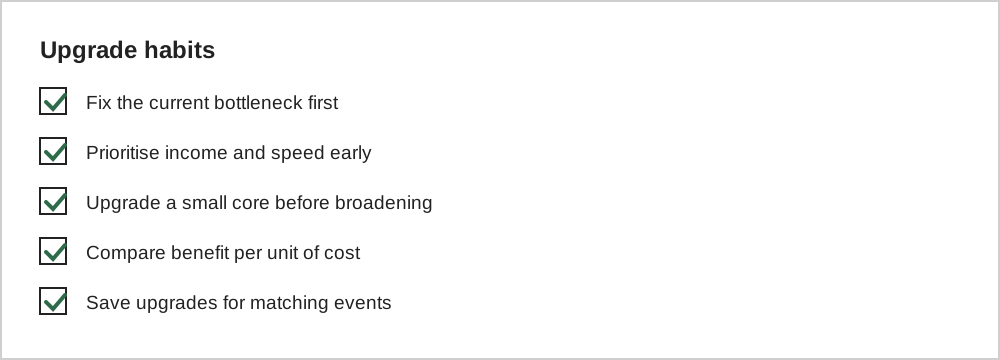
In games with many characters or units, upgrading a small core group first usually beats spreading resources thinly. A few strong pieces can clear content that many average pieces cannot. Once your core is strong, broaden out to cover new needs.
Watch for diminishing returns
Upgrade costs often rise steeply while the benefit stays similar. Comparing the improvement per unit of cost helps. If one upgrade gives a 5% boost for 100 resources and another gives 4% for 30, the second is far better value, even though the first looks more impressive.
Plan around events
Many games run events that give extra rewards for specific actions, such as upgrading buildings or spending a particular currency. Saving upgrades for those windows can multiply their value. Our guide on events and limited-time offers explains how to plan.
A worked example
Imagine a tower defence game where you have 1,000 coins. Option A upgrades your main damage tower from level 5 to 6 for a 10% damage increase. Option B unlocks a slowing tower that reduces enemy speed by 30%. If enemies are slipping past your defences, the slowing tower helps every other tower deal more damage, so it often provides more value than a small boost to one tower.
The principle applies in most games: upgrades that multiply the effectiveness of others usually beat upgrades that add a small amount to one thing. Look for slows, buffs, economy boosts and resource multipliers before raw stat increases.
Avoiding spread-thin accounts
A common mistake is upgrading many characters or buildings a little at a time. The account then has no single strong option for difficult content. Most games reward depth first: get a small core to a strong level, then broaden. If you are unsure, check which upgrades the game asks for in its hardest current challenge and prioritise those.
Common questions
Is it ever worth upgrading everything evenly?
Even upgrades can make sense when a game requires many different units or characters at once, such as games with several teams for different modes. Even then, it usually pays to bring a core group up first.
What if I made bad upgrade choices early?
Many games offer ways to reset or refund upgrades, sometimes during events. If not, focus future resources on your best pieces. Early mistakes usually matter less as the game continues.
How do I know which upgrade gives the best value?
Compare the improvement with the cost. Some games show exact numbers; others require experimentation. Community guides and wikis often calculate value per cost for popular games.
The short version
Upgrade what is actually blocking you, favour upgrades that compound, concentrate on a small core first, and compare value per cost rather than raw size. It sounds simple, but it is the difference between steady progress and a pile of half-upgraded pieces.